Social Media
Facebook Lost 3.2M Nigerians, TikTok Gained 3M & Instagram Took The Fall.
The data we have been presented with tells us Instagram is shrinking in Nigeria. But read properly, it says something quite different to what the industry has spent this year repeating, including me, who had come to the same conclusion.
28 July 2026
Almost every media plan, agency recommendation and confident post about Nigerian social media traces back to one document. It is called Digital 2026: Nigeria, put together by DataReportal with We Are Social and Meltwater, and for most people it is the only comprehensive free source that exists. It is free, it is sitting there, and you can open it in about a minute.
Which means an entire industry is reading off a single sheet of paper. That is worth sitting with before we even get to what it says.
Here is what it says.
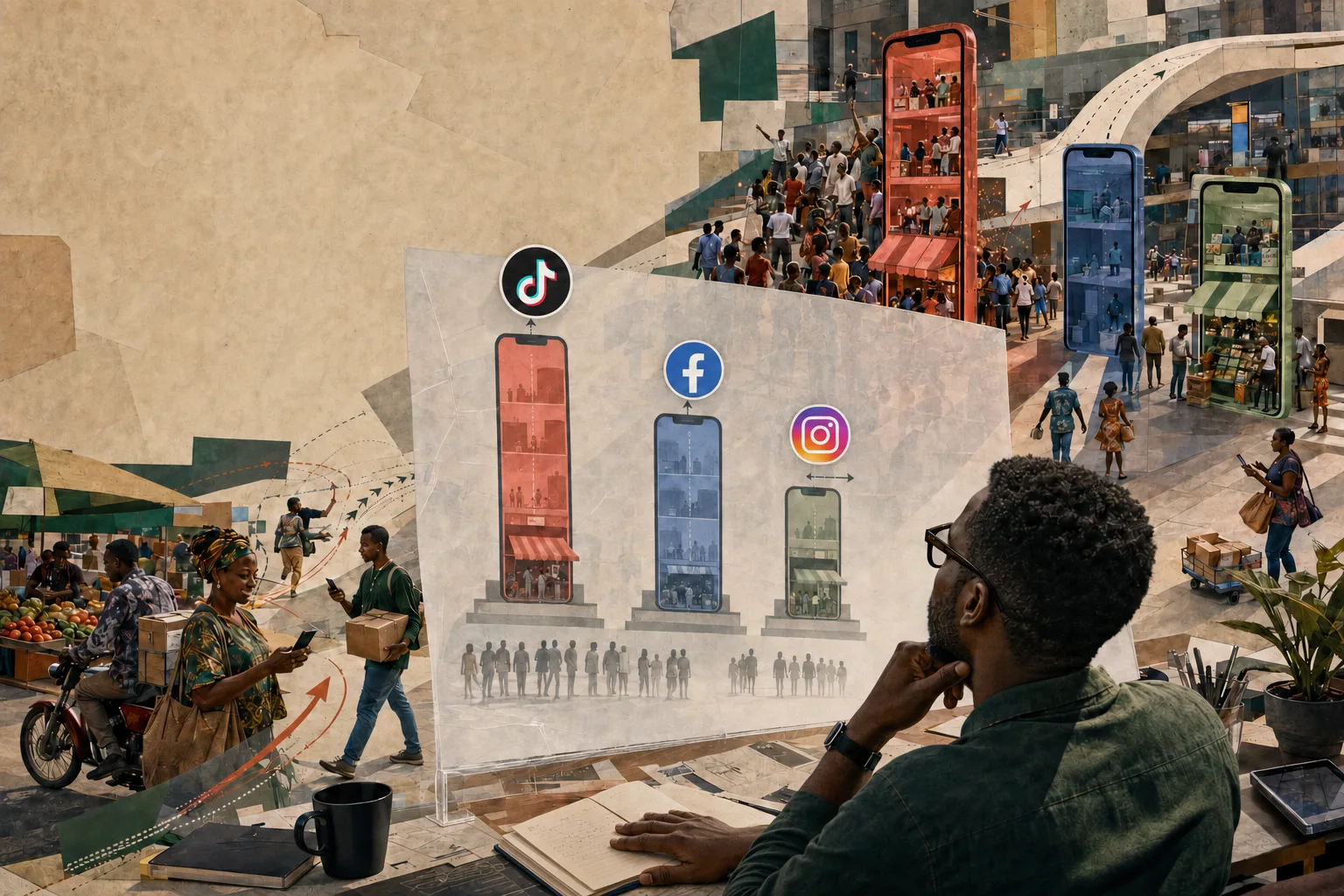
TikTok reaches 47.8 million Nigerian adults. Facebook 38 million. YouTube 30.5 million. Snapchat 23 million. LinkedIn 13 million. Instagram 10 million. X just under 7 million.
Year on year, TikTok is up 43.4 percent, Snapchat up 30.2 percent, LinkedIn up 18.2 percent, YouTube up 13 percent, Facebook up 6.9 percent. Instagram is down 6.1 percent and X is down 10.7 percent.
That table is the basis of most of the platform advice being sold in Lagos right now. And there are at least five things wrong with the way it is being used, which I know because I was using it that way myself.
The date on the tin is not the date of the data
The report is called Digital 2026. The fieldwork behind it is from October 2025, and it was published on 8 November 2025.
So the 2026 in the title is a naming convention. When somebody stands up in a meeting in the middle of this year and says the 2026 numbers show, they are describing Nigeria as it stood nine months earlier.
In a country where TikTok added fourteen and a half million people in a single year, nine months is not a rounding error. It is a meaningful chunk of the thing you are trying to measure.
These are not users, and the report says so
The figures are advertising reach, which is the platforms’ own estimate of how many people you could theoretically put an advert in front of. DataReportal states plainly in its own notes that estimated audience size is not a proxy for monthly or daily active users, or for engagement.
Nobody reads that line, me included. The numbers get repeated as though they are counts of human beings, and then somebody makes a budget decision off the gap between two estimates that the platforms generate themselves and quietly revise whenever it suits them.
The third one is where I got caught
A few weeks ago I put that Instagram figure up on my WhatsApp status, down 6.1 percent, and got into a back and forth with somebody about what it meant. My position was that Instagram is shrinking in Nigeria, TikTok has taken the market, and anyone still building around Instagram is behind.
I had not opened the report. I had absorbed the number the way we all absorb numbers now, secondhand, out of somebody else’s deck, and repeated it with more confidence than I had earned.
Instagram is down 6.1 percent year on year. That part is true. But in the same report, in the most recent quarter it covers, July to October 2025, Instagram is up 1.0 percent. It fell across the year and then stopped falling at the end of it.
So the honest sentence is not that Instagram is shrinking. It is that Instagram shrank, and then in the last window anybody measured, it did not.
And Facebook does the exact opposite, which is the part that genuinely surprised me. Year on year Facebook is up 6.9 percent, and that is the number everybody quotes. Quarter on quarter it is down 7.8 percent, which is 3.2 million people gone in three months, and it is the single sharpest movement anywhere in that dataset.
Read that again, because I had to. The biggest recent decline in Nigerian social media is not Instagram at all. It is Facebook. Nobody is saying it because the annual figure points the other way, and the annual figure is the one that gets copied into the slide.Then there is a coincidence that trips people up
Total social media user identities in Nigeria: 47.8 million.
TikTok’s ad reach in Nigeria: 47.8 million.
Same number, twice, in the same document. They measure completely different things, because TikTok’s figure counts adults only and sits against the adult population, while the identities figure is a different measure against everybody. But they appear near each other and they are identical, and I have already seen them used interchangeably.
Which gives you the nonsense conclusion that every social media user in Nigeria is on TikTok and nowhere else.
And since we are being careful, that applies to the headline at the top of this page too. Facebook lost 3.2 million last quarter and TikTok gained 3 million in the same window, which looks like a clean transfer, and it is not. Facebook’s number counts all ages against the total population and TikTok’s counts adults only against the adult population. Treat the symmetry as a coincidence worth noticing rather than as three million people walking from one app to the other. The Facebook against Instagram comparison is sound, because those two are measured the same way.
And LinkedIn is not even the same kind of number

Which means when you line these platforms up against each other, which is the only thing anybody actually uses this table for, you are ranking a number that counts activity against a number that counts registration.
The report warns you about most of this
This is the part that stayed with me. Nearly everything I have just described is flagged by DataReportal in its own methodology notes.
It advises significant caution when comparing figures against previous years. It says Meta made meaningful revisions to its published audience data, so the numbers are not directly comparable with earlier reports. It notes that a platform correcting its own data or clearing out fake accounts can produce what looks like a trend but is really just housekeeping.
So some of the movement we are all reading as Nigerian consumer behaviour may be Meta tidying its books.
The document is being misused in ways the document itself predicts. And that is not a research problem, because the research is fine and it is free and it is sitting there. It is a reading problem.
What is actually true
TikTok’s growth in Nigeria is real and large enough that measurement noise cannot explain it away. Up 43.4 percent on the year and still up 6.7 percent in the last quarter. Both directions agree, which is the test that matters.
Snapchat is genuinely growing, at 23 million, and almost nobody in Nigerian marketing is planning for it at all.
X is genuinely declining year on year, though it did tick up slightly at the end.
Instagram and Facebook are both unclear, because for both of them the year and the quarter point different ways.
And every one of those sentences describes October 2025.
What I would do on Monday morning
Open Meta Ads Manager and TikTok Ads Manager yourself. Set the location to Nigeria, put in whatever targeting you actually use, and read the audience estimate.
It costs nothing, you do not have to spend a naira or run anything to see it, it takes about ten minutes, and it is nine months fresher than any deck you have been handed. Then write today’s date next to whatever you find.
After that, treat the number as a planning estimate rather than a fact, because that is all it has ever been.
And when somebody hands you a platform recommendation with a percentage on it and no date attached, ask them where it came from and when it was counted. Watch what happens.
Now the part where I tell you what I still think
Everything above is checkable. This next bit is my read, and I am marking it clearly so you can disagree with it.

I still think Instagram is in trouble in Nigeria. I just think I was pointing at the wrong evidence.
The reason Instagram has held on here has very little to do with attention, because TikTok took that argument some time ago and is not giving it back. Instagram has held on because it is where Nigerians actually sell things. The DM that becomes an order. The page that functions as a shopfront. The comment section that closes the deal. Commerce is the real moat, not reach, and every founder running a small business off an Instagram page knows this even if they have never said it that way.
Which means the question that decides Instagram’s future in this market is not whether TikTok gets more attention. It already has more attention. It is whether TikTok becomes somewhere you can complete a sale.
That has already started. TikTok Live selling is happening in Nigeria right now. And TikTok Shop, the actual commerce infrastructure, has not launched here yet. Here is the detail that made me sit up. On 18 June this year, TikTok and the International Chamber of Commerce opened a Digital Commerce Lab in Lagos, free training for Nigerian small businesses on selling online, with Nigeria named as the launchpad for the whole of Sub-Saharan Africa.
So TikTok is currently teaching Nigerian business owners how to sell, in a market where it does not yet have a shop for them to sell in. Draw your own conclusion. Mine is that you do not build the seller base first unless you intend to give them somewhere to sell.
If that shop opens properly in Nigeria, Instagram loses the one thing it still holds here. And that will show up in the numbers long after it has already happened to the businesses.
Which, if you have read this far, is rather the point. By the time the report tells you, it was true nine months ago.
SOURCES
- DataReportal, Digital 2026: Nigeria. Published 8 November 2025, data reference date October 2025. Every platform figure, both the annual and quarterly changes, and the methodology caveats.
- DataReportal, Digital in Nigeria, the country hub with the historical series
- DataReportal on Meta’s reporting changes, the reference for why year on year comparisons are unsafe
- Technext, 18 June 2026, TikTok and the ICC launch the Digital Commerce Lab in Lagos