Regulation
What Nigeria's big tech probe says about how you're building in the market.
Nigeria's probe into Meta, Google and X is part of a regional pattern. For founders operating in the Nigerian market, it changes the risk profile of platform-dependent strategies in ways worth understanding now.
23 July 2026
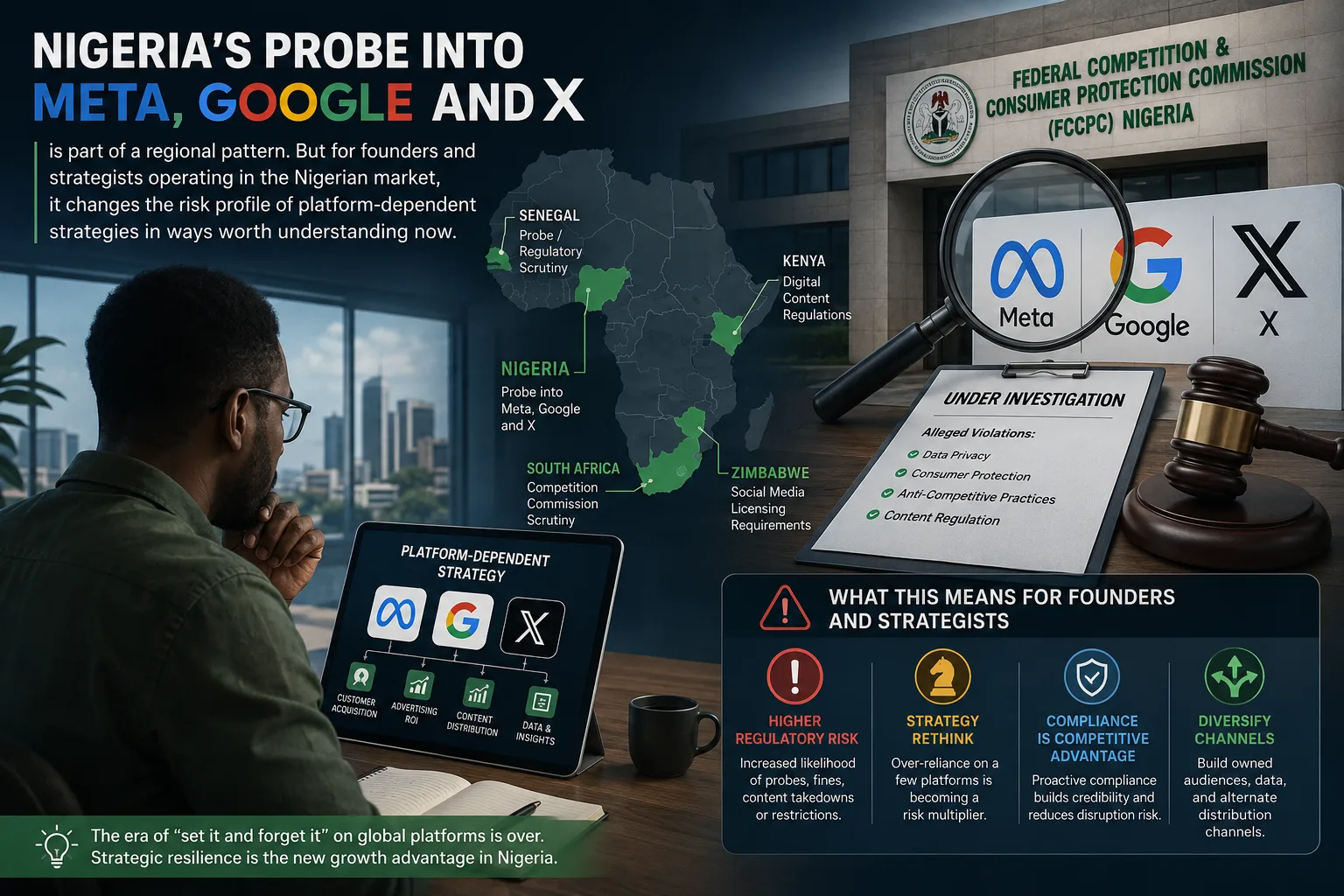
In April 2026, Nigeria extracted 32.8 million dollars from Meta following a competition and data investigation. In November 2025, South Africa's Competition Commission secured R688 million, roughly 40 million dollars a year over five years, from Google in an enforced settlement covering the use of local news content. In July 2026, President Tinubu directed the FCCPC to open a formal investigation into Meta, Alphabet, X, and generative AI platforms, following a petition from Nigeria's largest media organisations.
These are not isolated regulatory events. They are three data points in a pattern: African governments are building the institutional capacity to extract commercial value from platforms that have, for most of the past decade, taken local content, local audience attention, and local market access largely without paying for it. The direction of travel is clear enough that any founder or strategist operating in the Nigerian market needs to understand it, not as background news, but as a signal with direct implications for how they build.
How South Africa negotiated its deal
The South Africa settlement is worth understanding in detail because it is the clearest available template for what Nigeria's investigation could produce.
South Africa's Competition Commission ran a 24-month formal inquiry into digital news markets. The process included five rounds of information requests, public and in-camera hearings, expert submissions, consumer surveys, and a provisional report that gave Google an opportunity to respond before the final outcome. The investigation found Google dominant in digital news distribution and identified specific harms: the algorithmic demotion of publisher content, the use of that content in Google's own news surfaces without adequate commercial terms, and the effective transfer of advertising value away from publishers toward the platform.
Rather than pursue adversarial litigation, which would have delayed any meaningful relief for years, the Commission chose an enforced but negotiated settlement. The R688 million figure is structured across five years and broken into specific instruments: annual Google News Showcase payments to national publishers and the SABC, a Digital News Transformation Fund for small and community media, an AI Innovation Fund, and industry training. The deal is legally enforceable. Google agreed because the alternative was a drawn-out regulatory process with an uncertain but potentially larger outcome.
Analysts described it as a pragmatic win, not a structural fix. The money is real and the precedent is significant. But the underlying power dynamic did not change. Google still decides what surfaces and what does not. The settlement bought compensation and time, not independence. That distinction matters when reading Nigeria's situation.
What the dependency actually looks like
When we talk about Nigerian founders being dependent on Meta, Google, and X, the more useful question is: dependent in what specific way?
Meta controls the most significant portion of the Nigerian social internet. Facebook is the largest platform by user volume. Instagram is where most consumer brands build visual presence. WhatsApp Business is how a large proportion of Nigerian businesses actually communicate with customers and manage relationships day to day. It is not social media to most operators. It is infrastructure. Orders come in through it, customer relationships live inside it, and trust is built conversationally through it. That means the customer data, the relationship history, and the communication channel all sit inside Meta's ecosystem, not the founder's.
On the paid acquisition side, Meta Ads is the dominant channel for reaching Nigerian consumers at meaningful scale quickly. Google Ads is the second layer, particularly relevant for any business where customers search before buying. These two platforms effectively set the cost of customer acquisition for most of the market. When their targeting data changes, when algorithm shifts redistribute reach, or when regulatory action affects data access, Nigerian businesses feel it directly, because the measurement and acquisition model is built on the platforms' infrastructure.
X occupies a different position in the Nigerian context. The user numbers are smaller, but the Nigerian audience on X skews toward professionals, journalists, founders, policymakers, and opinion leaders. It punches above its weight in terms of the conversations that shape reputations and build institutional credibility. For anyone building thought leadership or B2B trust, X's Nigerian professional layer matters disproportionately relative to its size.
Beneath all of this is the content extraction problem the Nigerian Press Organisation raised in their petition. Nigerian journalists, publishers, and content creators have produced the material that trains generative AI models, fills Google's search results, and drives engagement across Meta's platforms. The value generated by that content has largely accrued to the platforms. This is a structural dependency: intellectual output creating value in a system the creator does not own or control.
How the calculus is changing
The regulatory shift does not eliminate these dependencies. The audiences are still on the platforms. That does not change because the government files an investigation. What changes is the risk profile attached to building a business on top of that dependency.
The first change is that Nigeria has demonstrated, repeatedly, that it will act. The 2024 WhatsApp data-sharing ban, the 220 million dollar Meta fine, the 32.8 million dollar settlement, and now the FCCPC probe form a pattern of escalating regulatory engagement. Any platform operating in Nigeria now has to price in the possibility of operational restrictions, fines, or forced commercial renegotiation. For a Nigerian founder whose business is heavily Meta-dependent, the question is no longer theoretical: if Nigeria imposes operational constraints similar to those it imposed around data sharing, what happens to the acquisition funnel?
The second change is leverage at a structural level. The South Africa deal, Nigeria's own settlement history, and the FCCPC investigation collectively establish a reference point. African regulatory bodies have demonstrated they can extract commercial value from the largest technology platforms in the world. This does not immediately change how a founder uses Meta Ads today. But it signals that the long-term cost of platform access in the Nigerian market is trending upward. Building a business model that assumes cheap, frictionless platform access in perpetuity is a worse assumption today than it was two years ago.
The third pressure runs in parallel: the emergence of AI-powered search as a meaningful discovery channel. AI search operates entirely outside the Meta and Google Ads ecosystem. It rewards clearly attributed human expertise, structured thinking, and consistent publishing. Businesses that build owned authority now are simultaneously hedging against platform risk and positioning for the channel growing fastest in conversion rates. The regulatory shift and the AI search shift are pointing in the same direction at the same time.
The structural conclusion
The South Africa deal was called a pragmatic win, not a structural fix, for a reason: taking money from the platform does not change who controls the distribution. The structural fix is owning the channel, the audience, and the relationship.
The practical translation for a Nigerian founder or strategist is not to abandon these platforms. The audiences are there. The argument is to stop treating them as the foundation and start treating them as a rented channel operating on top of owned infrastructure. WhatsApp Business for customer communication, but a list or database underneath it that belongs to the business. Meta Ads for acquisition, but a direct relationship model that survives changes to ad targeting and data access. Content published on X and LinkedIn, but original work on an owned surface that compounds independently of algorithmic decisions.
African governments are building the regulatory muscle to change the terms between the continent and the platforms that built their scale partly on its content. That does not automatically translate into infrastructure ownership for individual founders. The connection has to be made deliberately. The regulatory trend is the context. Owned infrastructure is the response.